

Child Marriage in Pakistan Drops from 37% to 22% Over a Generation, but Education Gap Persists
Tuesday, 13 October 2026
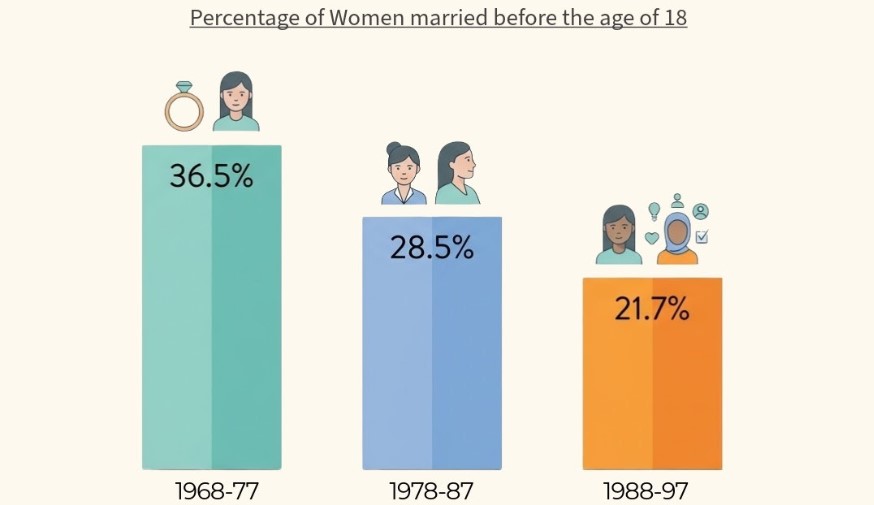
Gallup Pakistan analysis finds early marriage dropped from 36.5% to 21.7%, while 34% of women with primary education or less in the youngest cohort married before 18.
Hamid Khan Wazir
ISLAMABAD: The proportion of women in Pakistan who married before the age of 18 has fallen from 36.5 per cent to 21.7 per cent across three generations, marking a significant decline in child marriage, according to a new analysis by Gallup Pakistan Digital Analytics.
The analysis, based on the Pakistan Demographic and Health Survey (PDHS) 2017–18, found that child marriage rates declined from 36.5 per cent among women born between 1968 and 1977 to 28.5 per cent among those born between 1978 and 1987, before dropping further to 21.7 per cent among women born between 1988 and 1997.
The report attributed approximately half of the decline to increased educational attainment, while the remaining reduction reflected lower child marriage rates among women at similar levels of schooling.
The findings point to improvements in girls’ educational attainment as an important factor behind the decline. However, the report also highlights persistent disparities across education levels and provinces, indicating that child marriage remains a serious concern for many Pakistani girls.
Education emerges as a key factor
The report found that the overall 14.7-percentage-point decline in child marriage could be divided into two nearly equal components. Approximately 7.7 percentage points were associated with improvements in educational attainment, while another 7.1 percentage points reflected declining child marriage rates within the same education levels.
The proportion of women who had completed secondary education or attained a higher level of education increased from 16.6 per cent among the oldest cohort to 36.5 per cent among the youngest.
However, the analysis cautioned that the relationship between education and child marriage does not, by itself, establish cause and effect. Early marriage can interrupt a girl's education, while limited access to schooling may also increase her vulnerability to early marriage.
Major disparities persist across education levels
Despite the overall progress, the likelihood of marrying before 18 remained sharply different according to educational attainment. Among women in the oldest birth cohort, 43 per cent of those with no education or only primary schooling had married before turning 18. The proportion fell to 34 per cent in the youngest cohort.
Among women with secondary education, the rate declined from 24 per cent to 15 per cent across the same generations. The lowest rates were recorded among women with higher education, where the proportion marrying before 18 dropped from 4 per cent in the oldest cohort to 2.5 per cent in the youngest.
The findings underscore the persistent divide between women with limited schooling and those who attain higher education. In the youngest cohort, the rate of child marriage among women with no education or primary schooling was more than 13 times the rate among women with higher education.
Provincial differences remain significant
The analysis also recorded declines in child marriage across all four provinces, although the rates continued to vary considerably. In Punjab, the proportion of women married before 18 fell from 34 per cent in the oldest cohort to 17 per cent in the youngest. In Sindh, it declined from 40 per cent to 27 per cent.
Khyber Pakhtunkhwa recorded a decrease from 40 per cent to 30 per cent, while Balochistan saw the rate fall from 42 per cent to 29 per cent. Although the figures indicate progress nationwide, the report cautioned that the statistical uncertainty surrounding provincial estimates is considerable. Differences between provinces should therefore be interpreted carefully rather than treated as definitive rankings.
Methodology and limitations
Gallup Pakistan Digital Analytics based its analysis on the Pakistan Demographic and Health Survey 2017–18, using information on women's ages and reported ages at marriage to estimate child marriage across the population.
Because the survey interviewed only women who had ever been married, the researchers reconstructed estimates for all women by combining household roster information with age-at-marriage data.
The analysis covered women aged 20 to 49, ensuring that all those included had passed the age of 18 and that their exposure to child marriage could be assessed. Women aged 15 to 19 were excluded because their risk of marrying before 18 was not yet complete.
The report also acknowledged limitations associated with self-reported ages at marriage, including the possibility of recall errors among older women remembering events from two or three decades earlier. It noted a tendency for reported ages to cluster around 18. The findings, therefore, provide a picture of generational change rather than a direct measurement of child marriage prevalence among adolescent girls today.
Progress offers a basis for further action
The findings indicate that Pakistan has made substantial progress in reducing child marriage over a generation, but the benefits have not been distributed equally. The continued prevalence of early marriage among women with limited education, particularly in the youngest cohort, highlights the importance of improving access to schooling and addressing the social and economic barriers that prevent girls from completing their education.
At the same time, the report's findings suggest that educational expansion alone does not explain the entire decline. The reduction in child marriage within individual education groups indicates that other changes in social practices and circumstances may also be involved.
The central finding is that child marriage in Pakistan has declined substantially, but a girl's educational opportunities remain closely associated with her likelihood of marrying before the age of 18. Ensuring that progress reaches girls across all educational and provincial backgrounds remains a significant challenge.

More from Pakistan News




Comments
No comments yet. Be the first to comment!
Leave a Comment